top of page
EDD Digital Portfolio
Element I
Introduction
In Element I, the approved testing criteria from Element H are being tested. Each criteria below was tested to determine the success rate of each test. Every data table below went through a step process determining how to conduct the test and to determine if the test passed/failed. There was a requirement to record each test to determine its authenticity, the recording process took place for every criteria. Once the results of each test is determined, the passed tests will undergo little to no revision. The failed tests will have to be re-done using a different method for the next prototype. Every aspect of the testing process determines the improvement of the next prototype until there is a 100% success rate for every test, to determine the final prototype.
Testing Results
Temperature Data


Temperature Test


Putting the gel pack and ice bag for 5 hours in the freezer, was in the required range of 0°F - 46.4°F. The gel pack was still warm when it was taken out of the freezer and it reached a high temperature of 44°F. When the gel pack and ice bag were placed in the freezer for 8 hours, the interior temperature went up to 42°F. This temperature was in the range and allowed for the pillow to withstand the heat of the 98°F heater. This was the last prototype made due to the amount of time. Although the temperature was higher than the last prototype, there was more temperature consistency with this prototype. The pillow was a lot larger, by 4 inches, so the increase in temperature was expected.
Performance Data


Performance Test
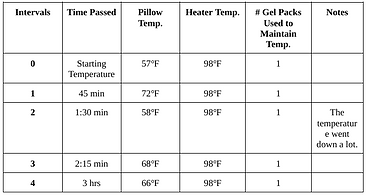

When there was 1 gel pack used for the pillow, the temperature went to 66°F by the end of the 3 hour interval. When 2 gel packs were used, The starting temperature started a lot warmer with 66°F. After the 3 hour intervals, the pillow temperature stayed within range and went down to 60°F. This was a successful final prototype because it stayed colder than the last prototype. Using 1 and 2 gel packs stayed within range passing this prototype.
Aesthetics Data


There was a total of 93 and 100 for the ranking of the pillow, in ranges from 3 - 5. Most of the score came from numbers 4 and 5, making the pillow above average. The stakeholders preferred this design better, since it was more fluffy and the case was a nice color. The final design passed the aesthetics criteria since most scores came from 4 and 5, making it a better improvement than the previous prototype.
Durability Data


There were a total of 4 items with each having three tests. All of the items in the 3 tests didn’t receive any major damage or any at all. One major concern was the durability of the pillow and the ice packs. The durability data confirms that a 6 ft drop will not damage or even be able to make a scratch in the items. The final prototype appears to be more durable than the previous prototype due to its new gel foam inside the pillow. Overall the final design passes the durability test.
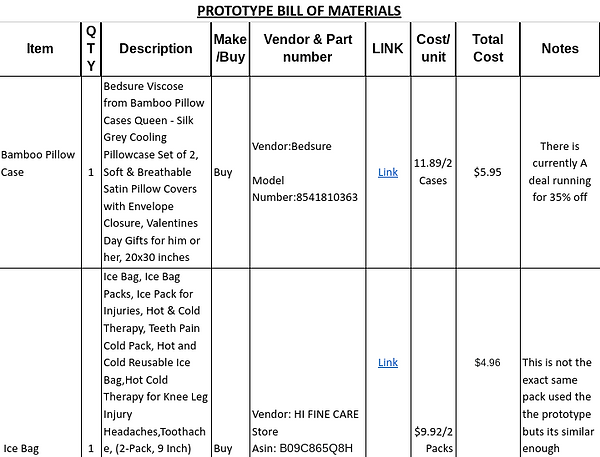


The first Polar Pillow prototype was in the price range. This data shows that $27.50 dollars did meet the minimum requirement of $25. There is a possibility to increase some materials. For the next prototype, there is $13.00 that can be used for higher quality materials. There is also a chance to include more materials to make the pillow be more fluffy and have a better design.


58 stakeholders were asked about the weight of the Polar Pillow. When the pillow had no Gel or Ice pack, 42 of the respondents said that the pillow was light, and easy to carry around. When the pillow had a Gel and Ice pack, 42 of the respondents said the pillow was average, and manageable to be able to move around the bed. Both of the questions passed since the majority of the responses came from the range of 1 - 3. Even though the pillow weight increased the results were produced the same. Passing the test as a result.
Conclusion
In Element I, the procedures approved from Element H were tested. The tests determined if the prototype made was helpful to the problem or did not help it at all. There were a total of 12 tests conducted. The first 6 tests were conducted from the first pillow prototype. These tests gave data for each 6 criteria and they were useful to find improvement for the next prototype. When those tests were over, the production for a second prototype was made. Once that was done, the final prototype was made, making the final 6 tests from that prototype. The final 6 tests determined if there was improvement since the last pillow. After all the data was collected, the 6 final tests showed an improvement in all of the criterias. The data was useful to confirm that the final prototype could be a real solution to the problem statement.
bottom of page